
Inside the Shop: An ASME-Certified Pressure Vessel Build From Cut to Coat

Updated: Jun 5
There is a particular satisfaction in watching a pressure vessel come together from raw steel plate. It starts as a stack of material on a shop floor. It ends as a precision-engineered piece of industrial equipment, ready to handle high-pressure service in an oilfield, refinery, or processing facility for decades to come. At LnL Fabrication in Colorado, this transformation happens every week. The team builds ASME-certified pressure vessels and process equipment for some of the most demanding clients in the energy industry, and every build follows the same disciplined process.
This article takes you inside the LnL Fabrication shop for a behind-the-scenes look at how a complete pressure vessel gets built. From material selection through coating and shipment, this is the full story of how serious industrial fabrication actually happens.
Why ASME Certification Matters
Before walking through the build process, it helps to understand what ASME certification actually means and why it matters so much in industrial fabrication. The American Society of Mechanical Engineers Boiler and Pressure Vessel Code is the governing standard for the design and construction of pressure-containing equipment in North America. Equipment that operates under pressure must be built to ASME standards, with rigorous documentation, qualified welders, certified procedures, and third-party inspection.
LnL Fabrication holds ASME Section VIII Division 1 certification, with the U stamp authorization that allows the shop to build code-stamped pressure vessels. This certification is not casual. It requires ongoing audits, qualified welding procedures, certified welders, complete quality control systems, and a documented commitment to the highest standards of industrial fabrication. Clients hire ASME-certified fabricators because the certification provides documented assurance that the equipment is safe, reliable, and built to the specifications it must meet.
Step One: Engineering Review and Material Procurement
Every pressure vessel project starts with an engineering review. The client provides design drawings, specifications, and operating conditions. The LnL Fabrication engineering team reviews everything for code compliance, fabricability, and any opportunities to improve constructability without compromising the design intent. This review often catches small issues that would have created problems downstream, saving the client time and money before fabrication begins.
Once the engineering review is complete, materials get ordered. Pressure vessel work uses specific grades of carbon steel, low-alloy steel, or stainless steel depending on the service conditions. Each material certification gets reviewed and matched to the project requirements. The traceability of every piece of material from mill to finished vessel is documented and maintained throughout the build, a requirement of ASME work that distinguishes serious fabricators from casual ones.
Step Two: Cutting and Forming
With materials in the shop, the fabrication work begins. The LnL Fabrication team uses precision cutting equipment to bring steel plate down to the exact dimensions called for in the design. Cuts get reviewed for accuracy, edges get prepared for welding, and parts get marked with the heat numbers that maintain material traceability.
Forming work shapes the steel into the curved sections that make up pressure vessel shells and heads. Rolling equipment turns flat plate into cylindrical shell sections. Forming presses shape vessel heads into the dished or elliptical profiles specified by the design. Each formed section gets inspected for dimensional accuracy and surface quality before it moves to the next stage.

Step Three: Welding the Pressure Boundary
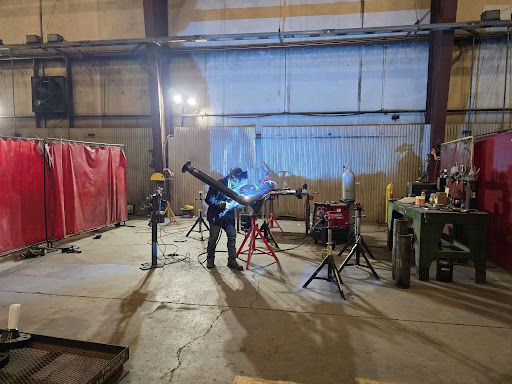
Welding is the heart of pressure vessel fabrication. Every weld on a code-stamped vessel must be performed by a certified welder following a qualified welding procedure, using approved materials, with documented inspection at multiple stages. This is not casual work. This is precision craft executed at the highest standards of the industry.
The LnL Fabrication welders combine deep technical knowledge with hands-on craftsmanship that comes only from years of practice. They know how to read a welding procedure specification. They know how to set up their equipment for the specific joint geometry and material thickness. They know how to deliver consistent weld quality across long passes on complex vessel sections. This is the craftsmanship that gives a finished vessel the integrity to perform safely in service for decades.
The Welding Inspections That Verify Quality
Visual inspection of every completed weld for surface quality, contour, and any visible defects.
Liquid penetrant testing on critical welds to detect surface-breaking discontinuities.
Magnetic particle testing on ferromagnetic materials to detect near-surface flaws.
Radiographic testing on full-penetration welds to verify internal weld quality.
Ultrasonic testing on thicker welds where radiography is impractical or insufficient.
Final dimensional inspection of the complete vessel against design tolerances.
Each inspection gets documented in the vessel's quality control records, building the complete fabrication history that supports the final ASME data report and U stamp.
Step Four: Heat Treatment
Many pressure vessels require post-weld heat treatment to relieve residual stresses from welding and ensure the final material properties meet the design specifications. The LnL Fabrication team coordinates heat treatment carefully, with proper time-temperature profiles, calibrated furnace equipment, and documented temperature records that become part of the vessel's quality file.
Heat treatment is one of those steps that looks simple from the outside but requires real expertise to do well. Improper heat treatment can leave residual stresses in the vessel, alter material properties unfavorably, or damage the vessel through thermal shock. The LnL Fabrication team handles this critical step with the discipline it deserves.
Step Five: Pressure Testing
Before any pressure vessel leaves the LnL Fabrication shop, it gets pressure tested to verify the integrity of every weld and the structural soundness of the complete vessel. ASME code requires hydrostatic pressure testing at 1.3 times the design pressure for new vessels. The test fills the vessel completely with water, raises the pressure to the test level, holds it for the required time, and verifies that no leaks or distortions occur.
Pressure testing is the moment of truth for pressure vessel fabrication. Decades of weld preparation, careful inspection, and disciplined construction either holds up under test conditions or it does not. For LnL Fabrication vessels, the work consistently holds up because the quality has been built into every step of the process, not added at the end.
Step Six: Surface Preparation and Coating
Once a vessel passes pressure testing, it moves into surface preparation and coating. The exterior gets blasted to a clean white metal finish, ensuring excellent adhesion for the coating system. The LnL Fabrication shop applies coating systems matched to the service environment, from standard industrial coatings for sheltered service to high-performance epoxy and urethane systems for outdoor or corrosive environments.
Quality coating work extends the service life of the vessel significantly, protecting the underlying steel from the corrosion that would otherwise shorten the vessel's useful life. The LnL Fabrication team selects coating systems carefully, applies them with proper surface preparation and atmospheric controls, and delivers finishes that hold up in the field.
Step Seven: Documentation and Stamping
Every ASME-certified pressure vessel gets a complete documentation package that travels with the equipment for its entire service life. The package includes design calculations, material certifications, welder qualification records, welding procedure documentation, inspection records, heat treatment records, pressure test records, and the final ASME Manufacturer's Data Report. This documentation is the official record of how the vessel was built and the verification that it meets all code requirements.
The vessel also receives its ASME U stamp, the physical marking that identifies the vessel as a code-stamped pressure vessel built by an authorized manufacturer. This stamp is the visible sign of everything the documentation proves.
Step Eight: Shipment and Field Support
With the vessel complete, stamped, and documented, it is ready for shipment to the client's facility. The LnL Fabrication team coordinates shipping logistics, including the heavy hauling permits and equipment required for moving large pressure vessels by road. The team can also provide field support during installation, ensuring the vessel gets placed and connected properly at its final destination.
The Smart Tools Behind the Craft
Behind the visible welding and fabrication work, LnL Fabrication uses modern tools that support better quality and faster delivery. AI-assisted weld inspection tools help quality control teams catch issues earlier in the build process. Digital documentation systems capture inspection records, photographs, and traceability data without the paperwork delays of older systems. Project management tools coordinate work across the shop floor, ensuring that materials, welders, and inspection resources are available when needed.
None of these tools replace the human craftsmanship that defines pressure vessel work. The welders still hold the torch. The fitters still set up the joints. The inspectors still make the calls. The tools simply support the work, removing administrative friction and helping the team deliver projects on schedule with the documentation rigor that ASME work demands. This is human and AI teamwork in a serious industrial setting.
Why Clients Choose LnL Fabrication
For energy companies, processing facilities, and other industrial operators who need ASME-certified pressure vessels, the choice of fabricator matters enormously. The wrong choice creates delays, quality problems, and field issues that cost time and money. The right choice delivers reliable equipment that performs for decades. LnL Fabrication has built its reputation on being the right choice for clients who care about quality, delivery, and long-term performance.
Decades of combined welding and fabrication experience on the shop floor.
ASME Section VIII Division 1 certification with U stamp authority.
Disciplined quality control systems that build quality into every step.
Clear communication and project management from quote through delivery.
Strong relationships with material suppliers, inspection services, and shipping providers.
A track record of delivering complex projects on schedule and to specification.
Start a Conversation About Your Next Pressure Vessel Project
If you have an upcoming pressure vessel or process equipment fabrication project, the LnL Fabrication team is ready to deliver. Visit lnlfab.com to learn more about the full fabrication capabilities, or follow the team on LinkedIn to see recent project work, in-production updates, and completed builds. The right fabricator makes all the difference. LnL Fabrication is ready to be that fabricator for your project.
#LnLFabrication #PressureVessels #ASMECode #IndustrialFabrication #SteelFabrication #WeldingIndustry #ManufacturingExcellence #ProcessEquipment #OilAndGasIndustry #QualityEngineering #HeavyFabrication #IndustrialEngineering #MetalFabrication #ColoradoManufacturing #ASMEUStamp


Comments