
Welded to Last: The Craftsmanship Behind LnL Fabrication's Oil and Gas Equipment

Updated: Jul 2

Step onto the shop floor at LnL Fabrication on any given day, and you will see something that defines the difference between commodity fabrication and serious industrial work. You will see welders who treat their work as a craft. You will see fitters who set up joints with the precision of machinists. You will see inspectors who care about every weld they sign off on. You will see a team that knows the equipment leaving their shop is going to serve in some of the most demanding environments in the energy industry, and they take that responsibility seriously.
This article is about the craftsmanship behind LnL Fabrication. It is the story of the welders, fitters, and trade professionals who build oil and gas equipment that holds up for decades. If you have ever wondered what separates a great fabrication shop from an average one, the answer is here.
The Craft of Industrial Welding
Most people think of welding as a single skill. In reality, industrial welding is a family of related disciplines, each requiring years to master. Different welding processes serve different purposes. Different materials require different techniques. Different joint configurations call for different approaches. A truly skilled industrial welder commands a deep portfolio of techniques and applies them with judgment that only comes from experience.
At LnL Fabrication, the welders work across multiple processes including shielded metal arc welding, gas metal arc welding, gas tungsten arc welding, and flux cored arc welding. Each process has its place. Stick welding for heavy plate work in less-than-ideal conditions. MIG welding for productive welding on clean structural work. TIG welding for precision work on critical materials. Flux cored for high-deposition welding in field positions. The team knows when to use each process and how to deliver consistent quality across all of them.
The Welding Certifications Behind the Work
ASME Section IX welder qualification for code-stamped pressure vessel work.
AWS structural welding certifications for heavy structural fabrication.
Position-specific qualifications including overhead, vertical, and horizontal positions.
Material-specific qualifications across carbon steel, low-alloy steel, and stainless steel.
Procedure-specific qualifications matched to the welding procedure specifications the shop uses.
These certifications are not paperwork. They are evidence of demonstrated welding capability tested under controlled conditions. Every certified welder at LnL Fabrication has proven their skill on the actual processes, materials, and positions required for the work they perform.
Why Oil and Gas Equipment Demands the Highest Standards
Oil and gas equipment operates in conditions that punish poor workmanship. High pressures. Corrosive fluids. Temperature extremes. Decades of continuous service. Field locations far from maintenance support. A weld that fails in a city office building creates inconvenience. A weld that fails in an oilfield production vessel can shut down a facility, threaten worker safety, and cost the operator millions of dollars in lost production and remediation.
For this reason, oilfield vessel manufacturing and gas production equipment fabrication demand standards that simply do not apply in commodity metalwork. Every weld matters. Every joint preparation matters. Every material specification matters. Every inspection matters. LnL Fabrication has built its reputation on understanding these stakes and delivering work that meets them consistently.

The Fitting Work That Happens Before the Welding
Behind every great weld is the fitting work that made the weld possible. Pipe and plate must be cut to precise dimensions. Joint geometries must be prepared with the correct angle, gap, and root face. Components must be aligned within tight tolerances and held in position with proper tacking. None of this work is glamorous, and most clients never see it. But without strong fitting, even the best welder cannot deliver quality welds.
LnL Fabrication invests in skilled fitters who treat their work as carefully as the welders treat theirs. The fitters work with precision measuring tools, follow detailed weld maps, and verify their setup before any arc gets struck. This discipline at the front end of the work is one of the reasons LnL Fabrication welds pass inspection consistently and hold up in service for decades.
Inspection as Part of the Process
Quality inspection at LnL Fabrication is not something that happens at the end of the project. It is part of the process at every stage. Visual inspection during fit-up to verify joint preparation. Visual inspection during welding to catch issues before they get buried under later passes. Final visual inspection on completed welds. Non-destructive examination including radiographic testing, ultrasonic testing, liquid penetrant testing, and magnetic particle testing as required by the project specifications.
This integrated inspection approach catches problems early, when they are easy to fix. By the time a piece of equipment reaches final inspection and pressure testing, the team has already verified quality at multiple stages along the way. The result is consistent first-pass success on inspections and reliable delivery of equipment that meets every specification.
The Materials That Demand Specialized Skills
Oil and gas work uses a range of materials that each demand specific welding skills and procedures. The LnL Fabrication team has experience across the full material range.
Carbon Steel Pressure Vessel Plate
Most oilfield production equipment uses carbon steel pressure vessel plate, typically ASME SA-516 grade 70 or similar materials. These materials are familiar to the team and form the backbone of most fabrication projects.
Low-Alloy Steel
Higher-pressure or higher-temperature service often calls for low-alloy steels like ASME SA-387 chrome-moly materials. These materials require careful preheat, controlled cooling, and post-weld heat treatment to deliver the final material properties the design requires. The LnL Fabrication team handles these materials with the discipline they demand.
Stainless Steel
Corrosive service applications often require stainless steel construction, including 304, 316, and duplex stainless grades. Stainless welding requires careful contamination control, proper shielding gas selection, and techniques that prevent the sensitization that can compromise corrosion resistance. The team brings the experience to do stainless work right.
Cladded and Lined Materials
Some applications use carbon steel base materials with a stainless steel cladding or weld overlay on the wetted surfaces. These cladded and lined materials require specialized welding techniques that maintain the cladding integrity while delivering full structural strength in the base material. LnL Fabrication has the experience to handle these complex material systems.
The Equipment LnL Fabrication Builds
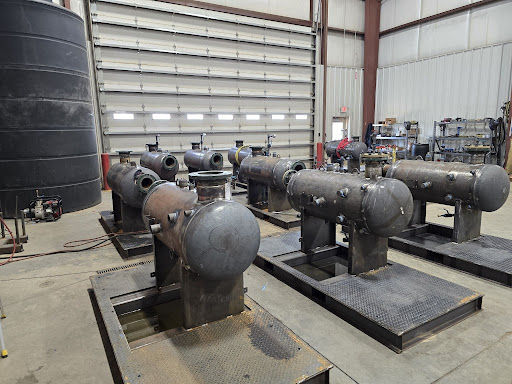
The LnL Fabrication shop produces a wide range of equipment for the oil and gas industry, with each project type drawing on different combinations of fabrication capabilities. You can see examples of completed work and ongoing builds on the LnL Fabrication LinkedIn page.
Separator vessels for oil, gas, and water separation in production facilities.
Production tanks and storage vessels for crude oil, produced water, and intermediate products.
Heat exchangers and shell-and-tube heat transfer equipment.
Skidded process equipment packages integrated with piping, valves, and instrumentation.
Pipe spools and process piping for facility tie-ins and equipment connections.
Custom industrial metalwork for specialized applications across the energy industry.
The Smart Tools Supporting the Craft
Modern industrial fabrication uses tools that previous generations of welders never had access to. AI-assisted weld inspection helps identify potential issues earlier in the build process. Digital weld monitoring systems capture parameters in real time, providing documentation that supports quality control without slowing down the work. Project management software coordinates work across the shop floor, ensuring that materials, qualified welders, and inspection resources are aligned for every project phase.
None of this technology replaces the human craft at the center of the work. The welders still own the arc. The fitters still own the setup. The inspectors still make the calls that determine whether work passes or needs to be redone. The technology supports the team. The craftsmanship belongs to the people. This is how a serious fabrication shop combines tradition and modern capability.

The Culture That Holds the Team Together
More than the certifications or the equipment or the technology, what makes LnL Fabrication a strong shop is the culture among the team. Welders and fitters take pride in their work. Veterans mentor newcomers. Everyone treats quality as a personal responsibility, not just a company policy. The team holds itself to standards that go beyond what code minimums require, because the people doing the work want to deliver equipment they would be comfortable signing their names to.
This culture does not happen by accident. It comes from leadership that values craftsmanship, hiring practices that select for the right values, and ongoing investments in training and skill development. The result is a team that delivers consistent quality on every project, year after year, regardless of how complex or demanding the work becomes.
Why This Matters for Clients
For oil and gas operators, midstream companies, processing facility operators, and engineering firms who hire LnL Fabrication, the craftsmanship behind every project translates into concrete benefits.
Equipment that passes inspection on the first attempt, without rework or delays.
Welds that hold up under pressure testing, hydrostatic testing, and decades of service.
Documentation that meets every regulatory and contractual requirement.
Project delivery on schedule, with clear communication throughout the build.
Equipment that serves reliably in the field, supporting the operator's production goals.
These outcomes are the predictable result of disciplined craftsmanship applied consistently across every project. They are why LnL Fabrication keeps earning repeat business from the most demanding clients in the energy industry.
Start a Conversation About Your Next Project
If you have an upcoming oil and gas equipment fabrication project, the LnL Fabrication team would be glad to deliver it for you. Visit lnlfab.com to learn more about the full fabrication capabilities, or follow the team on LinkedIn to see the welders, fitters, and projects that define the LnL Fabrication shop. The craft is real. The quality shows up in every weld. The team is ready for your next project.
#LnLFabrication #OilAndGasIndustry #IndustrialFabrication #ASMEWelding #PressureVessels #PipelineWelding #StructuralWelding #WeldingCraftsmanship #FabricationShop #EnergyIndustrySolutions #OilfieldEquipment #CertifiedWelding #MetalFabrication #IndustrialEngineering #PrecisionWelding


Comments